
Customer Stories
See how product teams communicate updates that users actually read
From Evernote and Meetup to DISH and Carta — real teams using changelogs, in-app widgets, and multi-channel distribution to keep users informed, reduce support load, and build trust.

Case study — Healthcare SaaS
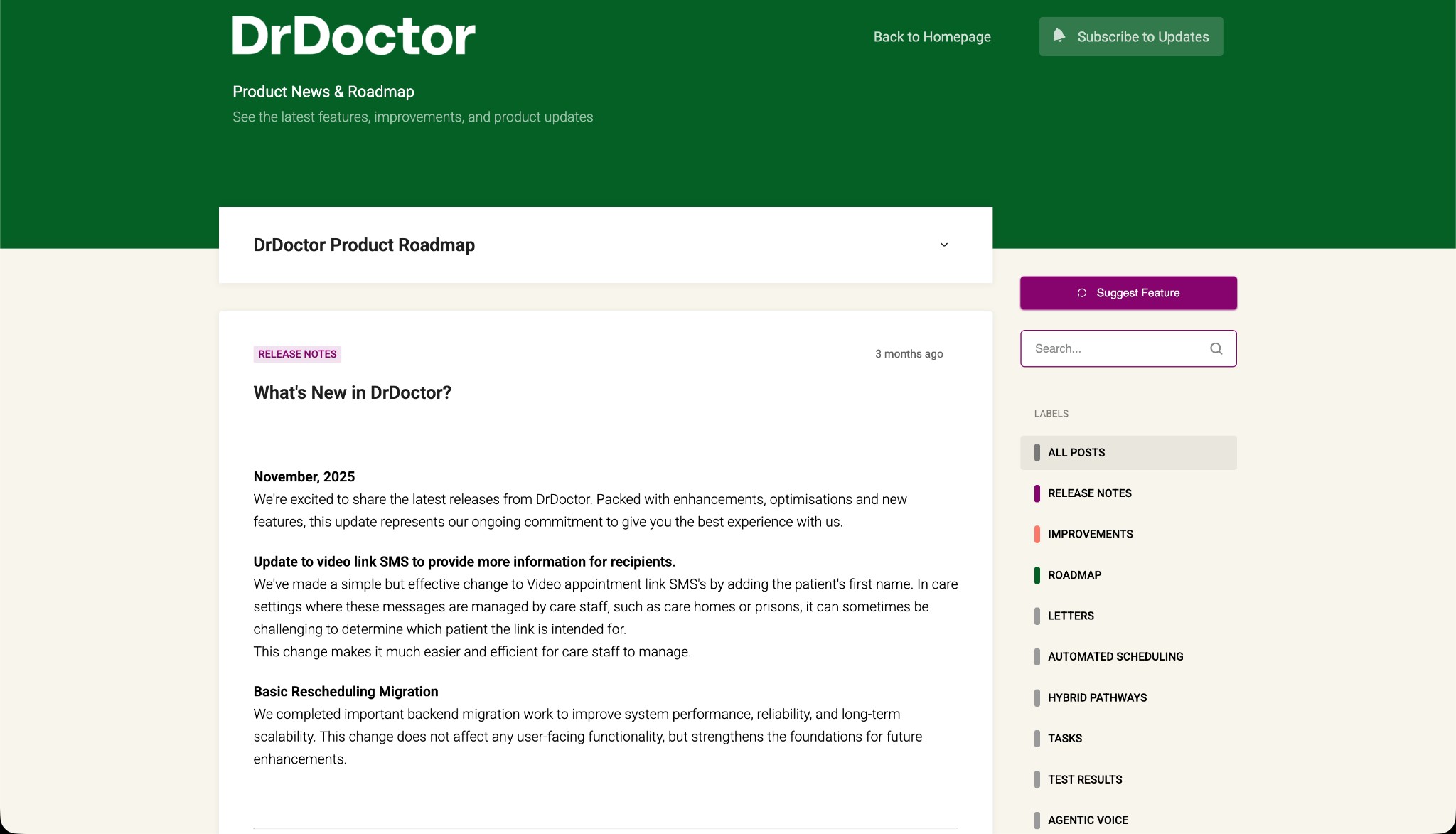
One place for product updates, roadmap, and feature requests
DrDoctor uses AnnounceKit as a single hub for product news and roadmap. Teams and users get a clear view of what's shipped and what's next — without chasing updates across tools or tickets.
- Their changelog doubles as a Product News & Roadmap centre: release notes, improvements, and roadmap posts live in one branded page.
- Labels keep everything scannable: users filter by what matters (e.g. Release Notes, Improvements, Roadmap) instead of scrolling a long feed.
- The Suggest Feature CTA lets users contribute ideas directly; feature requests are listed in public so the product team can prioritise with real signal.
Why it works
Users get a direct answer to "Where is the product heading?" on one page. Support and product spend less time repeating the same answers, and roadmap transparency builds trust and engagement.

Case study — Financial Services / Equity Management
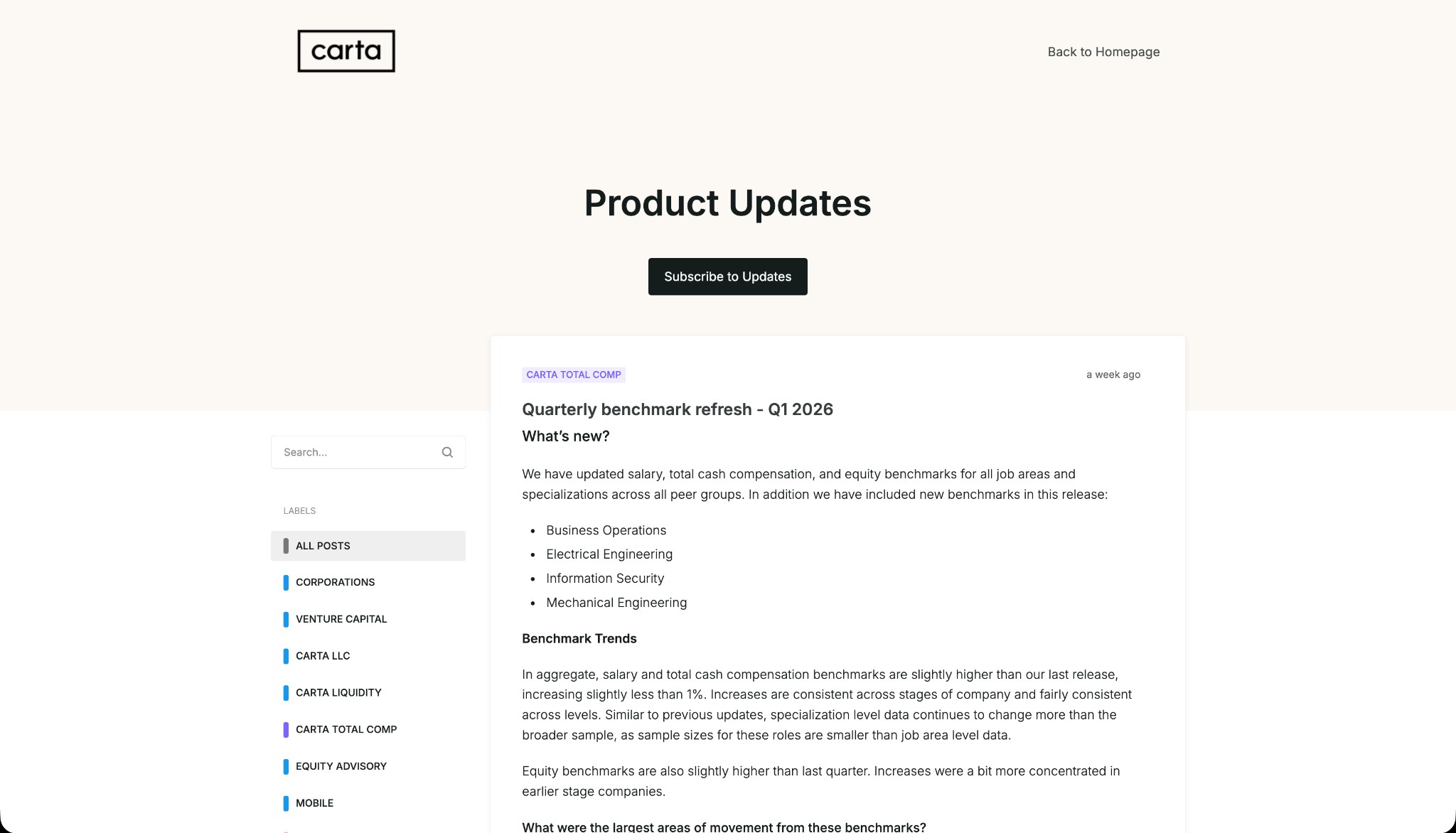
Segmented product updates for multiple audiences — at enterprise scale
Carta runs a single changelog that serves every stakeholder — from corporations and investors to fund admins and board members. Labels and audience segmentation ensure each update reaches the right people without the noise.
- One changelog, many audiences: Updates are tagged by product area (Total Comp, Liquidity, Venture Capital) and by audience (Employees, Investors, LPs, Board Members). Users filter and follow only what matters to them.
- Compliance-safe communication: Early Access and General Availability releases are separated. Compliance-related changes (409A, regulatory) are clearly marked with timestamps for full auditability.
- Quarterly updates made discoverable: Major releases like benchmark refreshes are published directly on the changelog — searchable, linkable, and always available. No more buried emails or PDFs.
- Single source of truth: Product, compliance, and CS teams all rely on the same page. Product publishes once; customer success shares links instead of explanations.
Why it works
Highly segmented communication without custom tooling. Clear governance for sensitive product updates. Scales across products, teams, and regions — and builds trust through consistent transparency.

Case study — Data & Analytics Platform
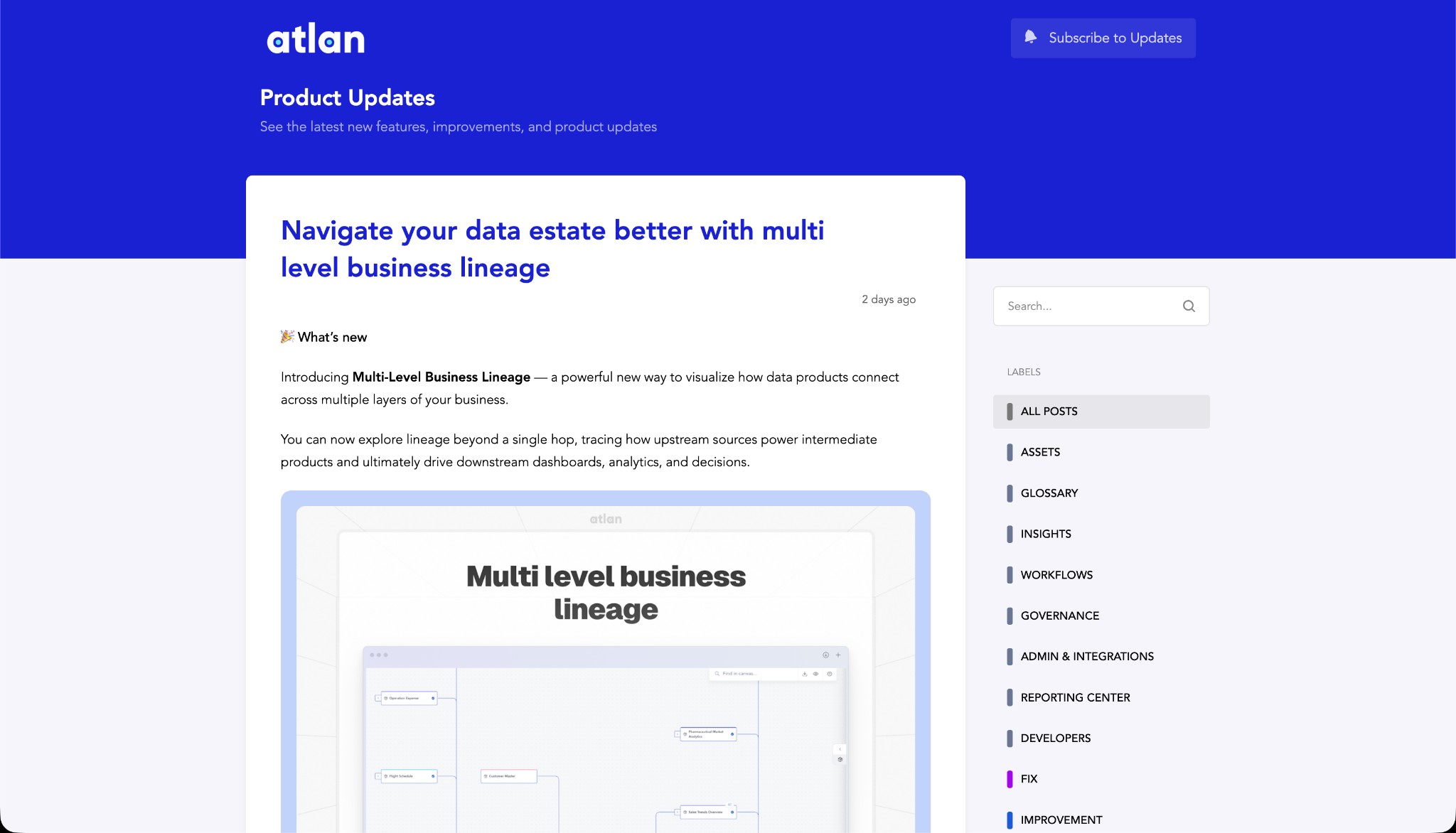
Multi-channel product updates that reach users wherever they are
Atlan publishes each update once and distributes it across public changelog, in-app notifications, and email — so critical changes are never missed, regardless of where users are.
- One update, multiple channels: Every release is published once and automatically distributed across the public changelog, in-app notifications, and email. Users stay informed whether they're inside the product or away.
- In-app notifications for high-visibility changes: Important updates like new integrations or breaking changes appear directly in the product UI with clear CTAs linking to full details. Dismissible messages avoid fatigue.
- Labels for complex product updates: Updates are categorized by functional area — Assets, Governance, Workflows, Integrations, Developers, Fixes — making the changelog searchable and filterable as the product grows.
- Engagement tracking built in: Teams see which updates get reactions and comments. Feedback flows from in-app widgets directly to product teams, closing the loop on every release.
Why it works
Single source of truth for product communication. Consistent messaging across email, in-app, and web. Labels keep complex updates structured and user-friendly. Stronger engagement without overwhelming users.

Case study — Enterprise Events & Streaming (Cisco)
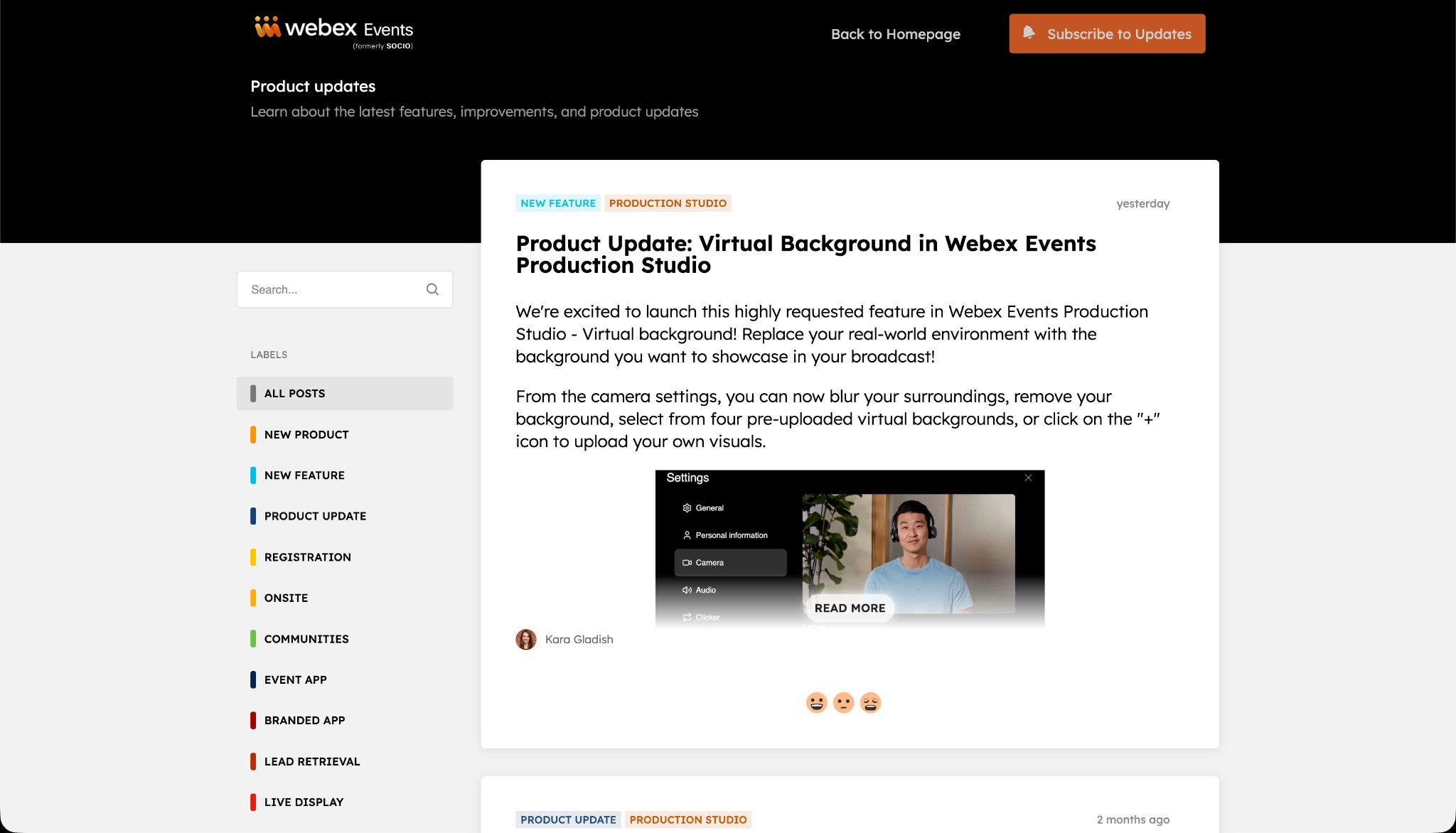
Structured product updates across a multi-module enterprise platform
Webex Events publishes detailed release notes across registration, onsite, event apps, branded apps, and production-grade streaming — all from a single changelog with labels that map to how customers actually use the platform.
- Labels that mirror product structure: Updates are organized by module — Registration, Onsite, Event App, Production Studio, Lead Retrieval, and more. Customers follow only what's relevant, without noise from unrelated areas.
- Deep, actionable release notes: Not just announcements — detailed how-to guides with supported formats, backward compatibility notes, and security details drive real feature adoption and reduce support traffic.
- Subscription-first distribution: "Subscribe to Updates" prominently drives opt-in. The changelog acts as an always-on archive while subscribers get updates pushed proactively — no reliance on manual email blasts.
- Long-term searchable archive: Years of release history with month-by-month navigation — critical for enterprise customers tracking feature introductions, version changes, and internal change management.
Why it works
One consistent home for product communication across many modules. Labels keep updates discoverable. Long-form, actionable posts drive real adoption. A deep archive supports enterprise governance and continuity.

Case study — AI-Powered Customer Experience
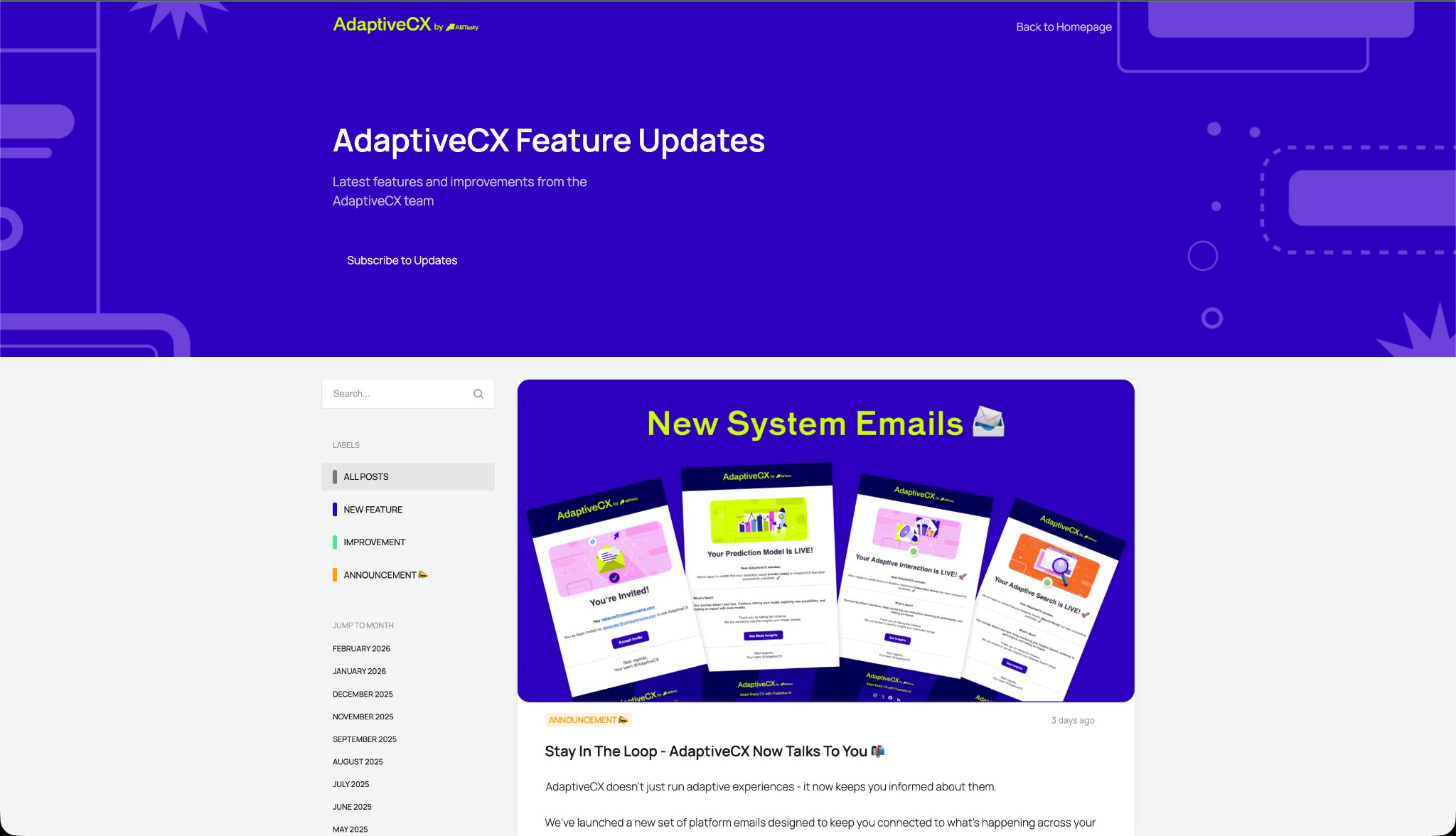
A public updates hub that keeps users confident through rapid product evolution
AdaptiveCX (formerly Wandz.ai) runs a branded feature updates page that serves as both a product communication hub and a trust-building asset — especially during fast-moving product evolution and company rebranding.
- Clear labelling for different update types: Every post is categorised as Announcement, New Feature, or Improvement. Users scan the feed instantly and jump to what matters — no guesswork about urgency or scope.
- Changelog as the backbone of proactive communication: Rather than relying on one-off emails, AdaptiveCX publishes once and distributes through both the public hub and system emails — creating a "stay informed" loop that works even when users aren't in-product.
- Smooth transitions during rebranding: When Wandz.ai evolved into AdaptiveCX, the changelog became a permanent, linkable reference point. Users could revisit the context behind the change anytime — reducing confusion and building trust.
- Lightweight publishing workflow: The team maintains a steady release cadence with consistent formatting and branding via Theme Designer — turning product communication into a habit, not a project.
Why it works
A single branded destination for every product update. Proactive email distribution keeps users engaged without dashboard dependency. Clear structure scales effortlessly as the product grows and evolves.
Case study — Consumer Marketplace & Community Platform
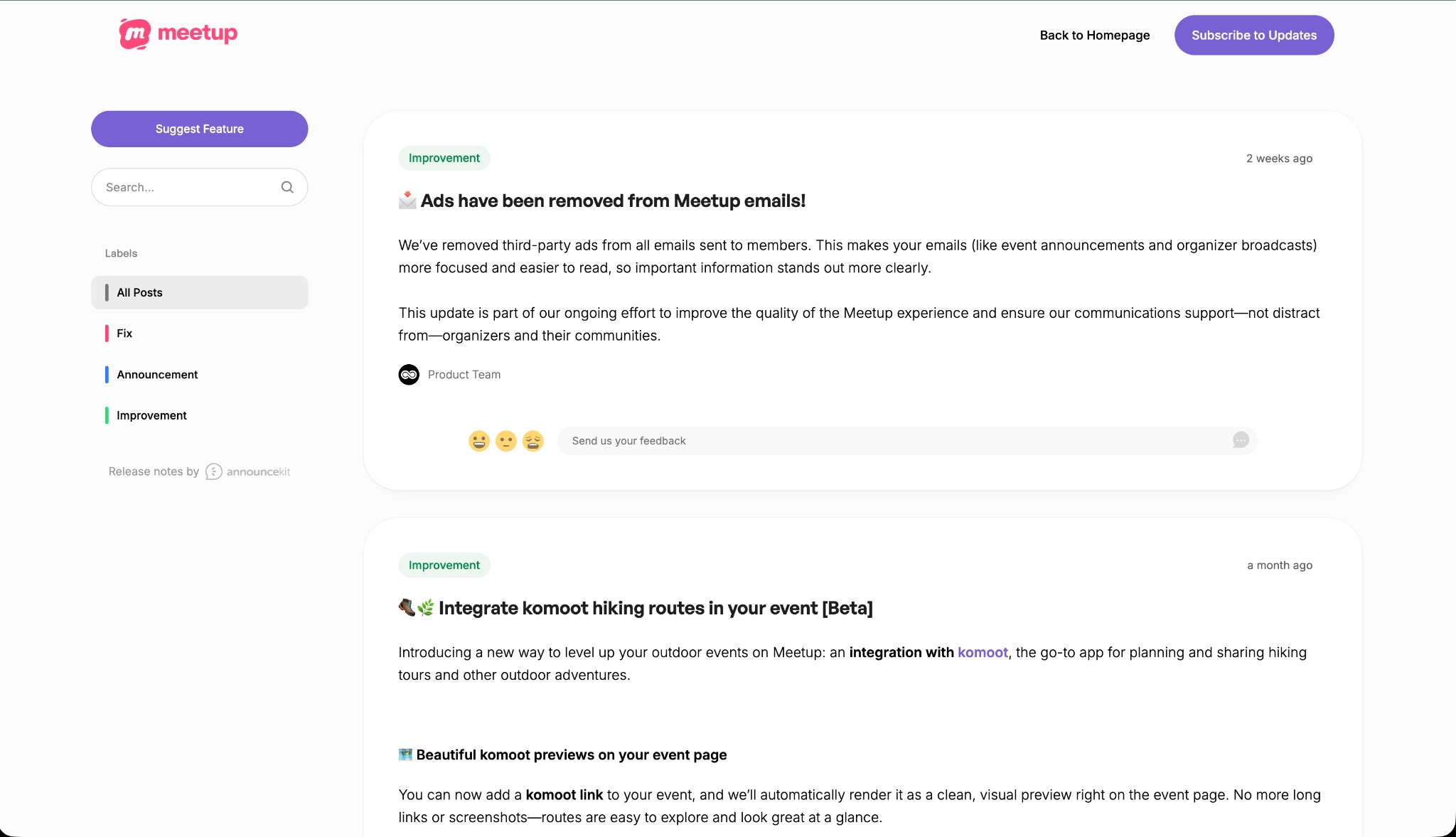
Not just feature updates — a single source of truth for product, policy, and community decisions
Meetup treats AnnounceKit as more than a product changelog. It's a centralised communication platform where product updates, company decisions, trust policies, and community-affecting changes all live in one transparent, searchable hub.
- Product + company updates in one place: Meetup publishes everything from feature improvements and bug fixes to account deactivation policies and ad removal announcements. Users never have to guess where the latest decisions live.
- Community governance through transparency: Sensitive changes — like inactive account deactivations, review visibility, and trust-related updates — are communicated with full context, timelines, and rationale. This builds trust at scale with millions of users.
- Feature requests on the same surface: The "Suggest Feature" CTA sits right alongside product updates — not in a separate tool. Users feel heard without leaving the communication flow, and the product team gets direct signal on priorities.
- In-app boosters for guaranteed reach: Critical updates are pushed via in-app notifications and segmented boosters — ensuring policy changes and high-impact releases reach the right audience, not just users who happen to check the changelog.
Why it works
Meetup runs a single communication surface for product, policy, and community. This eliminates scattered blog posts and one-off emails, while giving organizers and members a permanent reference for every decision. Feature requests close the feedback loop in the same place updates are published.

Case study — Productivity & Note-Taking
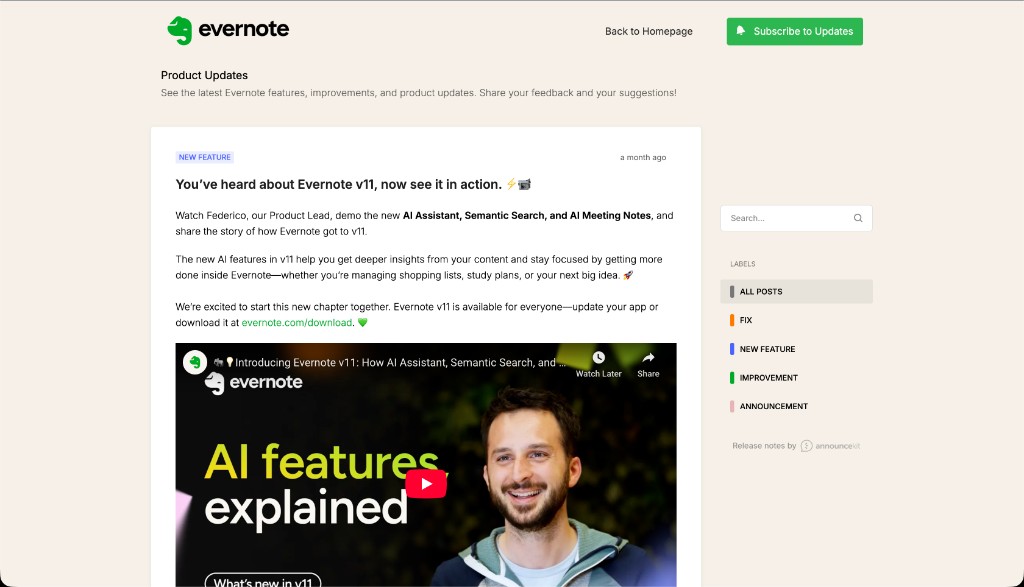
A changelog that tells the story behind the product — not just the features
Evernote uses AnnounceKit not just to announce changes — but to explain decisions, build trust, and narrate the product journey. Their changelog doubles as a product marketing channel where major launches, AI features, and security milestones all live in one branded, searchable hub.
- Storytelling over bullet points: Instead of dry feature lists, Evernote publishes narrative-driven posts that explain the "why" behind each release. Posts like "The story behind Evernote v11" turn a changelog into a product marketing surface that drives adoption and excitement.
- Video-first product education: Product demos, walkthroughs from the product lead, and embedded videos sit right inside the changelog. Users don't need to leave the updates page to understand how a feature works — the changelog becomes an onboarding tool.
- Security and trust alongside features: SOC 2 and compliance updates, and security announcements are published on the same surface as product updates. Enterprise and prosumer users see trust signals without hunting through help centres or blog archives.
- Clean labels that reduce cognitive load: Every post is tagged as New Feature, Improvement, Announcement, or Fix. Users decide in seconds whether an update is relevant — keeping engagement high without changelog fatigue.
Why it works
Evernote treats their changelog as a storytelling platform — not a technical log. Video-rich, narrative-driven updates turn passive readers into engaged users. Security and trust milestones live alongside features, reinforcing confidence at every touchpoint.

Case study — Restaurant Technology Platform (METRO)
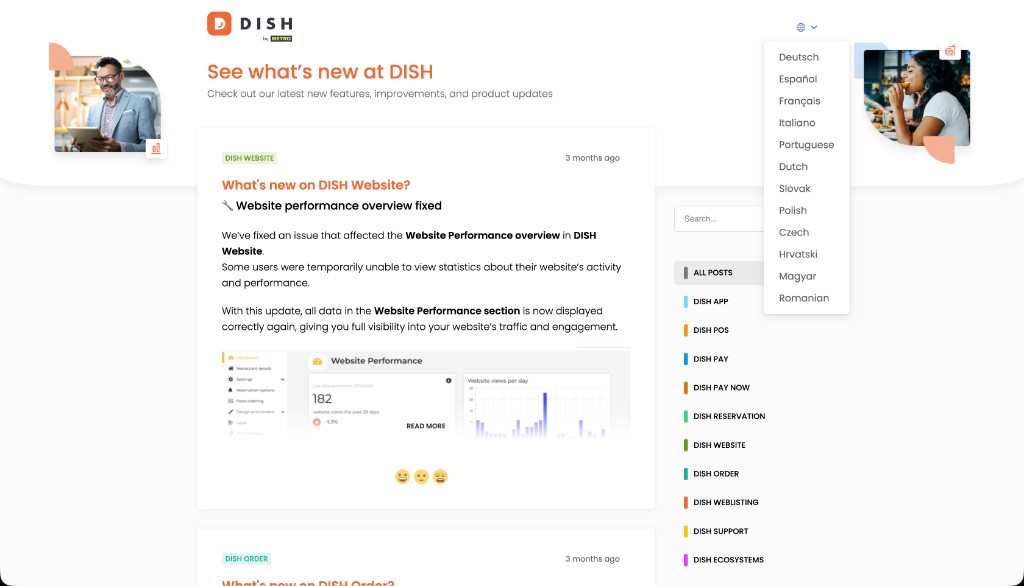
Multi-product, multi-language updates across a global restaurant platform
DISH by METRO runs AnnounceKit as a global communication backbone — coordinating product updates across multiple products, ten-plus languages, and diverse user segments from a single changelog. It's not a nice-to-have; it's organisational infrastructure.
- 10+ languages from one changelog: Every update is published in German, English, Spanish, French, Italian, Portuguese, Dutch, Polish, Czech, Hungarian, Romanian, and Croatian. Users read product news in their own language — making the changelog part of the global customer experience, not an afterthought.
- Product-level segmentation across an ecosystem: Labels map directly to DISH products — POS, Pay, Order, Website, Reservation, Weblisting, Ecosystems, and more. Users follow only the products they use, eliminating noise and keeping engagement high across a complex platform.
- Visual-first updates for non-technical audiences: Screenshots, UI walkthroughs, and step-by-step guides sit inside every post. Restaurant operators understand changes in seconds — reducing support load and accelerating feature adoption for an SMB user base.
- Internal and external on one surface: DISH manages internal ops updates, partner communications, and customer-facing release notes from the same system — using segmented labels and audience targeting to keep everything organised without separate tools.
Why it works
DISH runs a truly global communication operation from a single surface. Multi-language support makes every user feel addressed. Product-level labels prevent changelog fatigue across a complex ecosystem. Visual-first content drives adoption for non-technical restaurant operators at scale.
See what other customers say about AnnounceKit.
Read verified reviews